W8USR - Special Events
Museum Ships Weekend – USS Nautilus (N1S) Activation
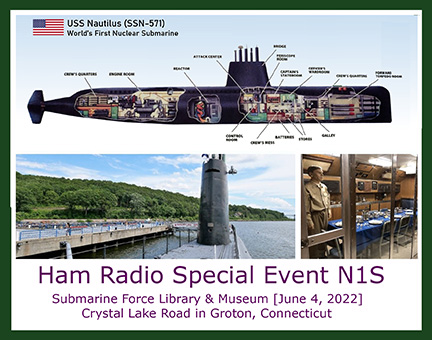
The historic USS Nautilus (SSN-571) permanently berthed in Groton, Connecticut.
The W8USR Logbook Entry & Event Overview
On June 4, 2022, station W8USR tracked and logged a successful contact with special event station N1S during the annual international Museum Ships Weekend. Running from June 3 to June 5, 2022, this massive public activation took place entirely on-site at the Submarine Force Library & Museum on Crystal Lake Road in Groton, Connecticut. Guest operators set up temporary pop-up canopies and antennas right around the museum's picnic patio area, coordinating about five active operating positions simultaneously to commemorate the history of the world's very first commissioned nuclear-powered submarine.
Station Note: Successful contacts with N1S were eligible for physical QSL confirmation cards via Harrison Solt (N1FAM) at 110 Vinegar Hill Road, Gales Ferry, CT 06335, requiring a Self-Addressed Stamped Envelope (SASE). The W8USR log was logged electronically, and I did not send for a paper QSL card for this event.
Target Frequency Plan & Operating Modes
Because Museum Ships Weekend is a high-traffic operation with over 75 vessels active on the airwaves simultaneously, N1S operators utilized a "search and narrow" approach. They targeted open slots as close to their core frequency markers as possible (typically within +/- 25 kHz) and broadcasted their coordinates to live spotting networks so hunters could track them down. Their target mode plans were structured across these bands:
- Voice Operations (SSB): Centers were established at 3.860 MHz, 7.260 MHz, 14.260 MHz, 18.160 MHz, 21.260 MHz, 24.960 MHz, and 28.360 MHz.
- Morse Code (CW): Targeted frequencies included 3.539 MHz, 7.039 MHz, 10.109 MHz, 14.039 MHz, 18.079 MHz, 21.039 MHz, 24.899 MHz, and 28.039 MHz.
- Digital Modes: Operators utilized standard data windows including 14.070 MHz (for PSK31) and 7.074 MHz / 14.074 MHz (for FT8).
History of the USS Nautilus, the First Nuclear Submarine
The USS Nautilus (SSN-571) made history as the world's first operational nuclear-powered submarine and the first watercraft to complete a submerged transit of the North Pole. Commissioned by the United States Navy in 1954, the vessel was the brainchild of Admiral Hyman G. Rickover, often referred to as the "Father of the Nuclear Navy." Unlike its diesel-electric predecessors, which were severely limited by their need to surface or use snorkels to recharge batteries and run air-breathing engines, the Nautilus was powered by an S2W pressurized water reactor. This revolutionary technology allowed the submarine to remain submerged virtually indefinitely, limited only by the amount of food and supplies it could carry for its crew.
The true capabilities of the Nautilus were proudly demonstrated during Operation Sunshine in August 1958. Under the command of William R. Anderson, the submarine embarked on a top-secret mission to accomplish what had previously been impossible: navigating beneath the Arctic ice cap. On August 3, 1958, the Nautilus successfully reached the geographic North Pole, proving that nuclear submarines could operate in the extreme environments of the deep ocean and completely altering global military strategy during the Cold War. The historic journey shattered multiple records, including the longest submerged cruise and the highest speed ever sustained by a submarine at the time.
After an illustrious 26-year career filled with various fleet exercises and technological advancements, the USS Nautilus was decommissioned in 1980. In recognition of its unparalleled role in maritime history, the vessel was designated a National Historic Landmark in 1982. Today, the historic submarine serves as a museum ship at the Submarine Force Library and Museum in Groton, Connecticut. It remains a striking monument to the dawn of the nuclear age and continues to educate thousands of visitors each year on the evolution of modern naval engineering.
Station Log: Contact History
| Special Event Call | Station Logged | Date Logged | Time Logged | Frequency Band | Operation Mode | Signal Report | On-Board Operator |
|---|---|---|---|---|---|---|---|
| N1S | W8USR | June 4, 2022 | 01:44 UTC | 40 Meters | SSB Phone | Sent 59 / Recv 59 | Club Op |