W8USR - Special Events
USS Midway Museum – Jamboree-on-the-Air Activation
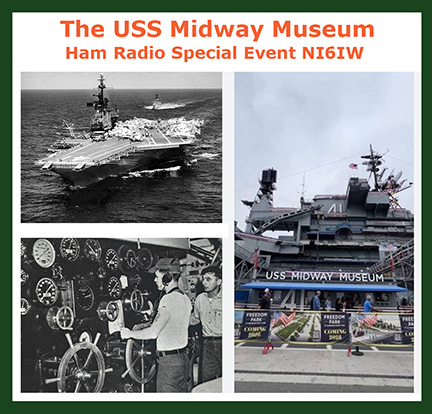
About the Special Event
On October 20, 2007, station W8USR tracked and logged a unique maritime operations milestone by contacting special event station NI6IW. This annual event was organized and conducted aboard the USS Midway Museum in San Diego, California. The purpose of this unique deployment was to participate in the annual Jamboree-on-the-Air (JOTA), an international scouting and amateur radio event that connects Boy Scouts and Girl Scouts around the globe using amateur radio waves. Volunteer operators aboard the museum ship gave youth scouts a rare chance to speak directly with an aircraft carrier to learn about communications, naval history, and technology. Operations took place inside three small, original radio rooms located just below the carrier's massive flight deck.
Shipboard Infrastructure & Antenna Layouts
The USS Midway Museum Radio Team successfully maintained a robust communication footprint running directly out of the carrier's historical radio rooms:
- Authentic Rigging System: To maintain the historical visual profile of the museum ship, the team was required to route all modern high-frequency amateur gear directly through the carrier's authentic, original combat-era vertical whips and twin-wire rigging networks.
- The Transceiver Bench: The primary workhorse station relied on modern, high-performance Elecraft K3 high-frequency transceivers. These radios are highly prized by museum stations for world-class receiver filters that easily handle the harsh, noisy RF environment of a steel-hulled ship.
- Antenna Matching Complex: Heavy-duty, high-power automatic antenna tuners were installed at the base of the historical military feed lines. This was necessary because modern amateur radio frequencies do not perfectly match the physical lengths of the original tactical antennas.
- Frequencies and Modes: The team focused voice (SSB), Morse code (CW), and digital operations on standard carrier frequencies, targeting 7.250 MHz (LSB) on 40 meters and 14.320 MHz (USB) on 20 meters, alongside PSK31 and regional VHF/UHF D-STAR voice links.
History of the USS Midway (CV-41)
The USS Midway (CV-41) was the lead ship of her class and one of the longest-serving aircraft carriers in United States naval history. Named after the pivotal World War II Battle of Midway, her construction began in 1943 at Newport News Shipbuilding in Virginia. She was the first U.S. carrier designed with an armored flight deck, which drastically improved survivability against kamikaze attacks. Commissioned on September 10, 1945, exactly eight days after World War II officially ended, she was too wide to pass through the Panama Canal and remained the largest ship in the world until 1955.
The Midway made history during Operation Sandy in 1947 by test-firing a captured German V-2 rocket from her flight deck, proving long-range missiles could be successfully launched at sea. In 1954, she deployed on the "Midnight Cruise" to assist in the evacuation of thousands of Chinese Nationalist troops and civilians from the Tachen Islands. During her SCB-110 modernization (1955–1957), she received an enclosed "hurricane bow" and an angled flight deck to support heavy naval jet aircraft operations.
In June 1965, Midway VF-111 pilots scored the first MiG kills of the Vietnam Conflict. Shortly after, a massive modernization doubled her flight deck area, enlarged her elevators, and installed brand-new steam catapults. She returned to Vietnam in 1972 for Operation Linebacker, flying grueling missions to mine North Vietnamese ports and strike heavily defended targets. In 1975, she played a legendary role in the evacuation of Saigon during Operation Frequent Wind, where her crew pushed millions of dollars worth of Huey helicopters overboard to allow a tiny South Vietnamese O-1 Bird Dog observation plane to land safely on the deck. In 1973, relocated to Yokosuka, Japan, she became the first American carrier forward-deployed to a foreign country.
During Desert Storm in 1991, the Midway served as the flagship for naval aviation forces in the Persian Gulf, launching round-the-clock airstrikes against Iraqi forces despite being the oldest carrier in the fleet. This great ship was officially decommissioned on April 11, 1992, after 47 years of continuous active service.
Transformation Into a Premier Naval Museum
After retirement, the ship sat in the Navy Reserve Fleet in Bremerton, Washington, for over a decade. A group of San Diego citizens envisioned turning the historic carrier into a premier naval museum to honor the city's deeply rooted military identity. In 2003, the Navy officially donated the ship to the San Diego Aircraft Carrier Museum organization. She was towed down the Pacific coast and docked at Navy Pier in downtown San Diego, officially opening to the public on June 7, 2004.
Today, the museum hosts well over 1 million visitors annually. The flight deck features more than 30 restored historic aircraft, spanning from WWII-era fighters like the F4U Corsair to modern supersonic jets like the F/A-18 Hornet. Truly a "City At Sea," visitors can fully explore the bridge, the captain's quarters, the massive galley, the engine rooms, and the original berthing quarters where the crew lived and worked during her decades on active duty.
Station Log: Contact History
| Special Event Call | Station Logged | Date Logged | Time Logged | Frequency | Frequency Band | Operation Mode | Signal Report | On-Board Operator |
|---|---|---|---|---|---|---|---|---|
| NI6IW | W8USR | October 20, 2007 | 16:12 UTC | 14.325 MHz | 20 Meters | SSB Phone | 55 | Ken |