W8USR - Special Events
60th Anniversary of the United States Air Force
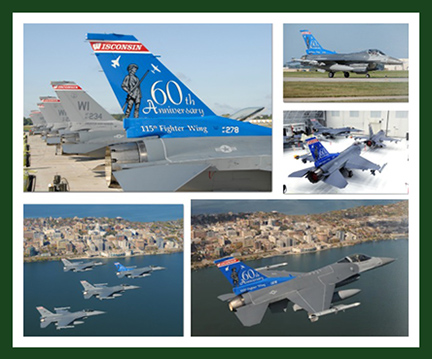
About the Special Event
On July 28, 2007, station W8USR logged a memorable on-air contact with special event station W9ZL, operating live from the grounds of the Experimental Aircraft Association (EAA) in Oshkosh, Wisconsin. This high-profile activation was organized by the Fox Cities Amateur Radio Club during the world-renowned annual EAA AirVenture fly-in convention to celebrate the 60th Anniversary of the United States Air Force alongside the annual gathering of aviation enthusiasts. Operating daily from 1300Z to 2100Z, the special event station primarily utilized High Frequency (HF) Single Sideband (SSB) voice mode on or near 14.270 MHz (20 meters) and 7.250 MHz (40 meters). They also maintained local VHF FM links on 146.52 MHz simplex and via the club's 146.76 MHz (− offset) repeater infrastructure to coordinate with visiting airborne and mobile operators.
The Historical Evolution of the United States Air Force
The United States Air Force (USAF) officially became an independent military branch on September 18, 1947, with the passage of the National Security Act of 1947. Before achieving separate status, the nation's military aviation capabilities evolved through a series of predecessor organizations within the U.S. Army:
- Aeronautical Division, U.S. Signal Corps (1907–1914): Established just four years after the Wright brothers' historic flight at Kitty Hawk, this pioneering unit was tasked to oversee all matters pertaining to military ballooning, airships, and mechanical flight.
- Aviation Section, Signal Corps (1914–1918): Saw the first combat deployment of American military aircraft during the 1916 Pancho Villa Expedition and underwent massive expansion following the U.S. entry into World War I.
- U.S. Army Air Service (1918–1926): Formed as a temporary wartime branch during WWI and later permanentized. This era featured legendary figures like General Billy Mitchell, who aggressively advocated for independent air power.
- U.S. Army Air Corps (1926–1941): Created by Congress to upgrade the status of military aviation and manage procurement, focusing heavily on developing long-range tactical bombing strategies.
- U.S. Army Air Forces (1941–1947): Formed to manage massive global expansion during World War II, growing to a peak strength of over 2.4 million personnel and nearly 80,000 aircraft to support the Allied victory.
Key Historical USAF Milestones
Since achieving independence in 1947, the USAF has led the nation's aerospace defense through critical global milestones:
- Independence & Leadership (1947): Stuart Symington became the first Secretary of the Air Force, and General Carl A. Spaatz was appointed as its inaugural Chief of Staff.
- Breaking the Sound Barrier (1947): Captain Chuck Yeager piloted the experimental Bell X-1 past Mach 1 over the California desert, cementing USAF leadership in aerospace engineering.
- The Berlin Airlift (1948–1949): Operation Vittles successfully sustained millions of West Berlin citizens entirely by air, proving the strategic capability of military air logistics.
- The Jet Age & Korea (1950–1953): The conflict saw the world's first large-scale jet-versus-jet aerial combat, pitting American F-86 Sabres against Soviet-built MiG-15s over the famous "MiG Alley."
- The Cold War & Vietnam (1950s–1970s): Strategic Air Command (SAC) maintained constant nuclear deterrence, while tactical operations in Vietnam introduced the widespread use of precision-guided munitions and electronic warfare.
- Modern Air Superiority (1991–Present): Operation Desert Storm showcased total air dominance using stealth aircraft (F-111, F-117) and advanced satellite integration, establishing the template for subsequent precision operations.
Station Log: Contact History
| Date | Special Event Call | My Callsign | Time (UTC) | Frequency / Band | Mode | Signal Report | Operational QTH Location |
|---|---|---|---|---|---|---|---|
| July 28, 2007 | W9ZL | W8USR | 18:29 UTC | 7.250 MHz (40 Meters) | SSB | 59 / 59 | EAA AirVenture • Oshkosh, WI |