W8USR - United States Radio
Hallicrafters S-53A
Technical Specifications
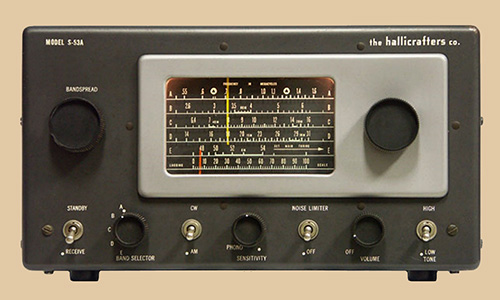
The Hallicrafters S-53A is a vintage 8-tube, single-conversion superheterodyne communications receiver produced in the 1950s. It features continuous coverage from 540 kHz to 31 MHz and 48 to 54.5 MHz across five bands, capable of receiving AM (Amplitude Modulation) and CW (Continuous Wave) signals. It has an Intermediate Frequency (IF) of 455 kHz. It has an Audio Output of 1 Watt (maximum) to a built-in 5" permanent magnet (PM) speaker. The power requirements are 105-125 V, 50/60 Hz AC consuming a maximum of 50 watts.
The S-53A uses 7 tubes plus a rectifier tube in the following lineup: a 6C4 Oscillator, a 6BA6 Mixer, 2 6BA6 IF Amplifiers, a 6H6 Detector, AVC, and Automatic Noise Limiter (ANL), a 6SC7 BFO (Beat Frequency Oscillator) and AF Amplifier, a 6K6GT AF Output, and a 5Y3GT Rectifier.
Radio History
Here at W8USR, we purchased our S-53A at the Dayton Hamvention sometime around 2010. In modern times, users generally view the Hallicrafters S-53A as a nostalgic entry-level shortwave and amateur receiver from the 1950s. While praised for its attractive mid-century design, solid build, and transformer power supply, collectors and radio enthusiasts agree that its actual receiver performance is subpar compared to other models in the brand's lineup.
We purchased this one primarily for restoration considerations (a special interest in Amateur Radio). The unit was packed with old paper wax capacitors, so to start with, we replaced all of them. We had to replace a broken dial cord. The band selector switch became stubbornly oxidized over the years and required some careful lubrication and patience to free up. But besides that, we got it working without too much difficulty. After a couple of years of service, we sold this one to another ham radio operator.
Antenna Routing
For restored radios (mostly all receivers), we have a 40 foot wire circling twice along the four walls where they meet the ceiling. That places it equivalent to about 16 feet off the ground outside (never actually measured). With that simple antenna system, I was able to hear signals from all parts of the globe depending on the time of day, the frequency, and of course propagation.
Station Role
After restoring the S-53A, during the months that we had it here, it was just used for SWL shortwave listening in the shack.