W8USR - Special Events
The Year of Pluto Special Event
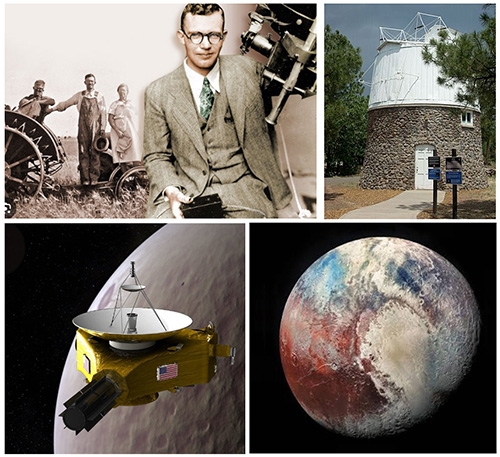
Event Details
The "Year of Pluto Amateur Radio Special Event" was hosted by the Northern Arizona DX Association. The event was operated from two locations jointly (the Lowell Observatory and Flagstaff, Arizona) celebrating the 85th anniversary of Clyde Tombaugh's discovery of Pluto at the Lowell Observatory and the 2015 flyby of Pluto by NASA's New Horizons deep space probe. The New Horizons Probe was launched in 2006 on an Atlas V Rocket achieving a launch velocity of 36,000 miles per hour, the highest ever achieved. On July 14, 2015, New Horizons passed 7,800 miles above Pluto. One ounce of Clyde Tombaugh's ashes were included in the New Horizons Probe as a tribute to Pluto's discoverer.
The Discovery of Planet X
It was at Lowell in 1930 that Tombaugh discovered Pluto. Following his discovery, Tombaugh earned bachelor's and master's degrees in astronomy from the University of Kansas in 1936 and 1938. While a young researcher working for the Lowell Observatory in Flagstaff, Arizona, Tombaugh was given the job to perform a systematic search for a trans-Neptunian planet (also called Planet X), which had been predicted by Percival Lowell based on calculations performed by his student mathematician Elizabeth Williams and William Pickering.
Starting April 6, 1929, Tombaugh used the observatory's 13-inch (330 mm) astrograph to take photographs of the same section of sky several nights apart. He then used a blink comparator to compare the different images. When he shifted between the two images, a moving object, such as a planet, would appear to jump from one position to another, while the more distant objects such as stars would appear stationary. Tombaugh noticed such a moving object in his search, near the place predicted by Lowell, and subsequent observations showed it to have an orbit beyond that of Neptune. This ruled out classification as an asteroid, and they decided this was the ninth planet that Lowell had predicted. The discovery was made on Tuesday, February 18, 1930, using images taken the previous month.
Naming the Ninth Planet
Three classical mythological names were proposed: Minerva, Cronus and Pluto. Minerva was eliminated as it was found to already be in use as the name of an asteroid. Cronus was written off because it was feared the astronomer Thomas Jefferson Jackson See, although being the primary supporter of it, would falsely take credit for it and was widely disliked. In Roman mythology, Pluto can render himself invisible, his name's first two letters are Percival Lowell's initials, and it was proposed by an 11-year-old English girl, Venetia Burney. In order to avoid the name changes suffered by Neptune, the name was proposed to both the American Astronomical Society and the Royal Astronomical Society, both of which approved it unanimously. The name was officially adopted on May 1, 1930.
Reclassification to Dwarf Planet
Following the discovery, it was recognized that Pluto was not massive enough to be the expected ninth planet, and some astronomers began to consider it the first of a new class of object – and indeed Tombaugh searched for additional trans-Neptunian objects for years, though due to the lack of any further discoveries he concluded that Pluto was indeed a planet. The idea that Pluto was not a true planet remained a minority position until the discovery of other Kuiper belt objects in the late 1990s, which showed that it did not orbit alone but was at best the largest of a number of icy bodies in its region of space.
After it was shown that at least one such body, dubbed Eris, was more massive than Pluto, the International Astronomical Union (IAU) reclassified Pluto on August 24, 2006, as a dwarf planet, leaving eight planets in the Solar System. Tombaugh's widow Patricia stated after the IAU's decision that while he might have been disappointed with the change since he had resisted attempts to remove Pluto's planetary status in his lifetime, he would have accepted the decision now if he were alive. She noted that:
“He was a scientist. He would understand they had a real problem when they start finding several of these things flying around the place.”
Hal Levison offered this perspective on Tombaugh's place in history:
“Clyde Tombaugh discovered the Kuiper Belt. That's a helluva lot more interesting than the ninth planet.”
Station Log: Contact History
| Date / Year | Special Event Call | My Callsign Used | Time (UTC) | Band | Mode |
|---|---|---|---|---|---|
| November 8, 2008 | N8F | W8USR | 18:25 UTC | 40 Meters | SSB |