W8USR - Special Events
First LORAN Experiments on the N.S. Savannah
About the Event
The K3S special event station commemorated the historic First LORAN Experiments. The shipboard station operated from 1330Z to 2100Z (UTC) using the 7, 14, 18, 21, and 28 MHz bands across both CW and SSB modes. The transmitter setup utilized a Kenwood TS-590 transceiver and a Yaesu FL-2100B linear amplifier running at 500W, fed into wide-spaced parallel dipoles suspended 50 feet above the ship's deck.
The Vessel & Atoms for Peace
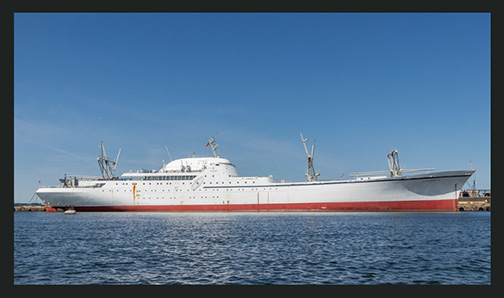
The N.S. (Nuclear Ship) Savannah, designed by George W. Sharp, Inc., of New York, was built between 1958 and 1961 by the New York Shipbuilding Corporation of Camden, New Jersey. It stands in history as the world's first commercial nuclear-powered merchant vessel. Launched on July 21, 1959, she began active sea trials in early 1962. Built at a cost of $46.9 million, the ship served as a monumental technological showcase for President Eisenhower's "Atoms for Peace" initiative.
As part of her mission, the ship acted as a floating ambassador. She successfully traveled over 450,000 miles and hosted hundreds of thousands of visitors in foreign ports, proving that a civil nuclear vessel could safely operate alongside standard commercial maritime traffic. Because its Babcock & Wilcox pressurized water reactor occupied the dead center of the ship, the superstructure and bridge were swept far aft, giving it a sleek, raked, white teardrop aesthetic meant to mimic a luxury yacht rather than a standard commercial cargo ship.
Early Maritime LORAN Navigation
The US Coast Guard operated a long-running LORAN-A and LORAN-C transmitting station in Savannah, Georgia. This land base provided the synchronized pulses used by ships and aircraft to triangulate their exact positions. As a highly advanced experimental showcase for cutting-edge maritime technology, the ship featured a full modern electronic navigation suite. By the time the N.S. Savannah was in service, LORAN-A was well-established, and ships of this caliber later upgraded to the more accurate LORAN-C system.
During its maiden voyages in the early 1960s, it relied heavily on LORAN-A receivers alongside traditional Radio Direction Finding (RDF), radar, and celestial navigation. As LORAN-C networks expanded throughout the 1060s and early microelectronics lowered receiver costs, the vessel utilized these advanced LORAN-C signals to safely navigate international waters without relying on clear skies for sight reduction.
Groundbreaking Atomic Propulsion
The propulsion system of the N.S. Savannah was a groundbreaking, 74-Megawatt (MW) thermal Pressurized Water Reactor (PWR) designed and manufactured by the Babcock & Wilcox Company. It integrated a custom-built atomic core with a modified steam turbine infrastructure, effectively using a nuclear reactor as a direct replacement for a traditional oil-fired boiler. The total weight of the reactor core, its massive shielding, the containment shell, and supporting equipment totaled 2,500 long tons—roughly equal to the entire displacement of a loaded World War II destroyer.
The core measured 17 feet high and 62 inches in diameter. It contained 32 fuel elements, each housing 164 fuel rods wrapped in stainless steel cladding. It was fueled by uranium oxide pellets enriched with Low-Enriched Uranium (average 4.4% U-235). The 16 innermost elements were enriched to 4.2%, while the outer 16 elements were enriched to 4.6% to optimize power distribution. Reactivity was managed by 21 boron-stainless steel control rods. These rods could be driven up or down to regulate output, and they featured an automatic hydraulic "scram" safety system to instantly shut down the reactor in an emergency. This single load of 32 fuel elements gave the Savannah an extraordinary range of 300,000 nautical miles at a cruising speed of 20 knots without a single refueling stop.
Station Log: Contact History
| Date | Special Event Call | My Callsign Used | Time (UTC) | Band | Mode | RST |
|---|---|---|---|---|---|---|
| March 21, 2026 | K3S | W8USR | 19:12 UTC | 40 Meters | SSB | 59 |