W8USR - Special Events
First Manned Moon Landing 50th Anniversary – WB4ICJ Activation
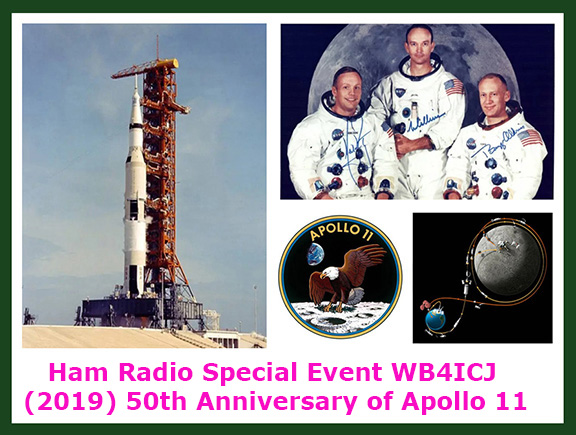
About the Special Event
On July 15, 2019, station W8USR tracked and logged a unique space history milestone by contacting the special event station being hosted by the Space Center Amateur Radio Society WB4ICJ. This activation took place from July 14 to July 20, 2019, in Geneseo, Illinois, to celebrate the golden 50th anniversary of humanity's first manned lunar landing. Managed by local operator Phillip H. McMillan (K9ZK) from his station on Wolf Road, this operation used a historic callsign deeply tied to NASA's legacy—WB4ICJ was originally assigned to the John F. Kennedy Space Center Amateur Radio Society in Florida. The station ran concurrently with a coordinated global amateur radio effort alongside the NASA Marshall Space Flight Center ARC (N4A) and the Cradle of Aviation Museum (K2CAM).
Station Infrastructure & Frequency Layouts
Operators maintained a highly active presence daily between 12:00Z and 23:59Z, utilizing Single Sideband (SSB) voice and FT8 digital modes across multiple bands:
- 20 Meters (14.240 – 14.260 MHz SSB): Operated as the primary daytime band to pull in long-distance (DX) contacts and stations from the far reaches of the United States.
- 40 Meters (7.230 – 7.260 MHz SSB): Deployed as the primary afternoon and early evening frequency band, providing excellent regional coverage.
- 80 Meters (3.800 – 3.850 MHz SSB): Activated late in the evening closer to the 23:59Z close-out time for close-in, domestic contacts as the higher bands died out.
- Digital FT8 Operations: Strictly adhered to standard global digital frequencies, including 14.074 MHz (20m), 7.074 MHz (40m), and 3.573 MHz (80m).
History of the Apollo 11 Mission
The Apollo 11 moon landing occurred on July 20, 1969. The mission was the culmination of the ambitious Apollo program, initiated by U.S. President John F. Kennedy in 1961 with the targeted national goal of landing a man on the Moon and returning him safely to Earth before the end of the decade. This high-priority milestone drove rapid technological advancements and a rigorous series of preparatory uncrewed and crewed missions (Apollo 7 through 10) that thoroughly tested spacecraft systems, lunar orbit maneuvers, and the specialized Lunar Module. The legendary crew selected for this historic attempt consisted of Commander Neil Armstrong, Lunar Module Pilot Edwin "Buzz" Aldrin, and Command Module Pilot Michael Collins.
On July 16, 1969, a massive Saturn V rocket launched Apollo 11 from the Kennedy Space Center in Florida. After a brief period in Earth orbit, the spacecraft's third stage ignited for "translunar injection," putting the crew on a trajectory toward the Moon. The journey across the 240,000-mile void took about three days, during which the crew performed a precise maneuver to extract the Lunar Module, Eagle, from its protective housing. On July 19, Apollo 11 fired its service propulsion engine to enter lunar orbit. On July 20, Armstrong and Aldrin entered Eagle and detached from the Command Module, Columbia, leaving Collins behind to pilot the command unit in orbit. During the final descent, the guidance computer triggered unexpected executive alarms, forcing Armstrong to assume manual control to steer the module away from a boulder-strewn crater. With only seconds of fuel remaining, Eagle touched down safely in the Sea of Tranquility as Armstrong radioed the historic words: "The Eagle has landed."
Scientific Legacy of the EASEP Suite
Hours later, Armstrong stepped onto the lunar surface, declaring, "That's one small step for [a] man, one giant leap for mankind." Because the crew had only 2.5 hours on the surface and faced immense uncertainties about working in pressurized suits, they left behind a streamlined, scaled-down bundle called the Early Apollo Scientific Experiments Package (EASEP), permanently transforming solar system science:
- Laser Ranging Retro-Reflector (LR3): A simple array of specialized mirrors and the only Apollo 11 experiment still operating today. Observatories on Earth fire lasers at the reflector to measure transit time, tracking the Moon's exact distance and proving it is slowly drifting away from Earth at a rate of roughly 1.5 inches per year.
- Passive Seismic Experiment Package (PSEP): The first seismometer placed on another world. Powered by solar panels and an isotope heater to survive the freezing lunar night, it detected thousands of moonquakes and meteoroid impacts, proving that the Moon possesses active internal seismic shifts.
- Lunar Dust Detector: A tiny device built to measure the rate of dust accumulation on spacecraft hardware. Dust turned out to be a major obstacle, clinging to spacesuits and causing the seismic package to overheat because rocket exhaust heavily coated the instruments during liftoff.
Symbolic Artifacts Left on the Surface
Beyond scientific gear, the Apollo 11 crew left behind four symbolic and historical items to mark humanity's first footprint on another world:
- The Goodwill Disk: A tiny, coin-sized silicon disc containing scanned messages of peace from leaders of 73 nations, along with lists of U.S. government officials and NASA administrators.
- Commemorative Space Medals: Specially minted tokens honoring fallen space explorers, including Soviet cosmonauts Yuri Gagarin and Vladimir Komarov, as well as the three American astronauts who died in the tragic Apollo 1 fire.
- The Lunar Plaque: Attached to the ladder of the descent stage (which remains on the Moon), this stainless-steel plaque is signed by the crew and President Richard Nixon, reading: "Here men from the planet Earth first set foot upon the Moon July 1969, A.D. We came in peace for all mankind."
- The Gold Olive Branch: A small solid gold pin shaped like an olive branch, left on the lunar surface by Neil Armstrong as a traditional global symbol of peace.
On July 21, Eagle's ascent stage successfully ignited, lifting Armstrong and Aldrin off the Moon to dock with Collins in Columbia. After transferring the lunar samples, the module was jettisoned, and the spacecraft fired its engines to head home. On July 24, 1969, the Command Module splashed down safely in the Pacific Ocean, completing the national vision and marking a monumental milestone in human history.
Station Log: Contact History
| Special Event Call | Station Logged | Date Logged | Time Logged | Frequency | Frequency Band | Operation Mode | Signal Report | On-Board Operator |
|---|---|---|---|---|---|---|---|---|
| WB4ICJ | W8USR | July 15, 2019 | 22:32 UTC | 7.240 MHz | 40 Meters | SSB Phone | 59 | SCARS Operator |