W8USR - Special Events
Mackinac Bridge 50th Anniversary Celebration
About the Club and the Event
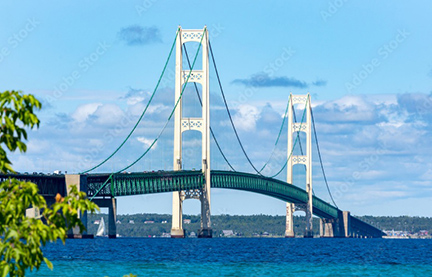
The special event on July 27, 2007 was hosted by the Straits Area Amateur Radio Club (SAARC) using the callsign W8M. The operation took place in St. Ignace, Michigan. The club set up this temporary station to commemorate the area's rich history and to highlight local amateur radio operations. The main purpose of the event was to celebrate the 50th Anniversary of the Mackinac Bridge in 1957, which is iconically known as the engineering marvel "linking two peninsulas" (Michigan's Upper and Lower Peninsulas).
The station was physically set up on the north side of the Straits of Mackinac in St. Ignace, Michigan. In amateur radio, a temporary 1x1 callsign designation (one letter, one number, one letter) can be specifically reserved for major historic operations or celebrations, providing a highly recognizable signal for operators tuning across the bands.
History of the Mackinac Bridge
The Mackinac Bridge, famously known as "Mighty Mac," is a 5-mile suspension bridge connecting Michigan's Upper and Lower Peninsulas. Designed by legendary engineer David B. Steinman and completed in 1957 for $99.8 million, the bridge eliminated arduous ferry lines and remains the longest suspension bridge in the Western Hemisphere.
Before the bridge was built, traveling across the Straits of Mackinac required slow, weather-dependent car ferries. During peak holiday seasons and harsh winters, waits to board the ferries could last up to 18 hours. As early as the 1880s, locals proposed permanent connections, and in the 1920s, the state actively studied floating tunnels and multi-span bridges. The Great Depression and World War II indefinitely delayed these initial plans, though the state created the Mackinac Straits Bridge Authority in 1934 to keep the dream alive.
The project finally gained momentum in the early 1950s when David B. Steinman was brought on board, and groundbreaking took place in May 1954. Building a massive structure in waters up to 200 feet deep required deep-water piers, specialized steel caissons, and a massive workforce of 3,500 people. The bridge opened to traffic exactly on schedule on November 1, 1957. Upon its opening, it was the longest suspension bridge in the world between cable anchorages. While other global bridges have since surpassed its main span (3,800 feet), it remains the longest suspension bridge in the Western Hemisphere by total length. The bridge was designated as a National Historic Civil Engineering Landmark in 2010. Every Labor Day, the bridge is closed to vehicular traffic to host the annual Bridge Walk, a tradition that draws tens of thousands of participants.
Station Log: Contact History
| Date / Year | Special Event Call | My Callsign Used | Time (UTC) | Band | Mode | RST |
|---|---|---|---|---|---|---|
| July 27, 2007 | W8M | W8USR | 23:38 UTC | 20 Meters | USB | 59 |