W8USR - Special Events
California Gold Discovery Anniversary – AG6AU Activation
The historic Marshall Gold Discovery State Historic Park valley in Coloma, California.
The W8USR Logbook Entry & Event Overview
On January 27, 2026, station W8USR tracked and logged a successful 20-meter contact with special event station AG6AU. This annual operation was hosted by the El Dorado County Amateur Radio Club (EDCARC) using their clever call sign representing the chemical symbols for silver [Ag] and gold [Au]. The station was physically set up on location at the Marshall Gold Discovery State Historic Park in Coloma, California—the exact historic valley where the 1848 California Gold Rush began.
Station Note: Commemorative QSL cards to confirm this contact were made available by sending a Self-Addressed Stamped Envelope (SASE) directly to the El Dorado County ARC at P.O. Box 451, Placerville, CA 95667. My contact record was logged directly into my station paper logbook, and I did not send for a physical QSL card.
Target Frequencies & Operations
Looking to pull hunting stations out of the local noise and static, the El Dorado County Amateur Radio Club targeted these standard frequencies across the high frequency bands (give or take a few kilohertz depending on spot interference and channel occupancy):
- 40 Meters: ~7.248 MHz Lower Sideband (LSB)
- 20 Meters: ~14.248 MHz Upper Sideband (USB)
- 15 Meters: ~21.348 MHz Upper Sideband (USB)
- 10 Meters: ~28.348 MHz Upper Sideband (USB)
The History of the California Gold Rush
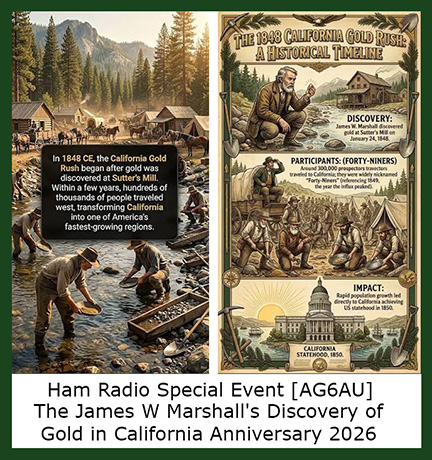
On January 24, 1848, a carpenter and sawmill operator named James W. Marshall changed American history forever when he noticed a few shiny flakes of metal in the tailrace of a mill he was constructing for John Sutter along the American River in Coloma, California. Marshall and Sutter initially tried to keep the discovery a secret, fearing a sudden influx of people would ruin Sutter’s agricultural empire. However, the news quickly leaked out, and by mid-1848, the frantic rush for wealth had begun, ultimately altering the demographic, economic, and cultural landscape of the entire continent.
The following year, the phenomenon reached a fever pitch as roughly 80,000 "Forty-Niners" flooded into California from across the globe, braving perilous sea voyages around Cape Horn or treacherous overland treks across the Great Plains. To extract the gold, these early prospectors relied on simple placer mining, harvesting loose gold that had eroded into stream beds. Armed with nothing more than a basic metal pan, a miner would scoop up dirt and river water, swirling it gently so the heavier gold settled to the bottom. As surface gold grew scarcer, they quickly scaled up to wooden contraptions like the cradle (or rocker) and long "sluice boxes," which used diverted river water to wash massive amounts of gravel over ridges that caught the heavy gold flakes far faster than a single pan ever could.
This massive influx of people and technology transformed San Francisco from a sleepy hamlet into a booming metropolis almost overnight, fueling the rapid construction of railroads, banks, and towns, and accelerating California's path to official U.S. statehood in 1850. Tragically, the two men at the center of the discovery never profited from the wealth they unleashed. Squatters overran Sutter's land, while angry prospectors forced Marshall off his claims. Marshall spent his remaining decades drifting from place to place before dying penniless in 1885 in a small cabin just miles from where he first struck gold.
Station Log: Contact History
| Special Event Call | Station Logged | Date Logged | Time Logged | Frequency Band | Operation Mode | Signal Report | On-Board Operator |
|---|---|---|---|---|---|---|---|
| AG6AU | W8USR | January 27, 2026 | 22:14 UTC | 20 Meters | SSB Phone | Sent 59 / Recv 59 | Club Op |