W8USR - Special Events
Eagle Harbor Lighthouse – K8E Private Expedition
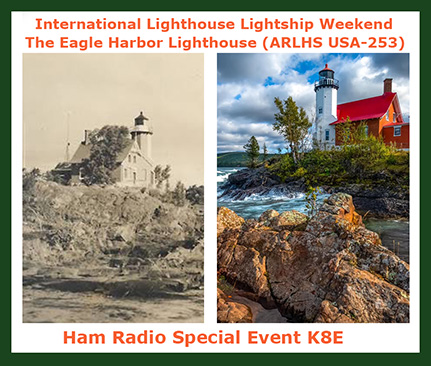
About the Special Event
On August 18, 2007, station W8USR tracked and logged a unique remote operations milestone by contacting special event station K8E. The International Lighthouse Lightship Weekend activation from Eagle Harbor was executed entirely as a private, multi-operator expedition organized and funded directly by Mike Rudzki (N8MR) and his close circle of operating friends. To complete this dedicated remote lighthouse DXpedition, the team traveled from Livonia, Michigan, to the northernmost tip of the Keweenaw Peninsula, unpacking their personal gear and operating right out of the light station grounds. Every bit of the equipment, fuel for generator power, travel expenses, and the printing of custom certificates came straight out of the operators' own pockets.
Expedition Crew & Operators
- Mike Rudzki (N8MR): Lead Organizer & Operator
- Angela Rudzki: XYL Support Crew
- Lynette Rudzki (KC8NAH): Station Operator
- Vincent Tarnowski (KA8FFM): Station Operator
- Mike Cook (N8MC): Station Operator
Eagle Harbor Light Station History
The Eagle Harbor Lighthouse is one of the most vital and historic navigational beacons on Lake Superior, sitting out on the rocky northern coast of the Keweenaw Peninsula in Michigan’s Upper Peninsula. Authorized by Congress in 1849 to safeguard ships carrying copper during the region's massive mining boom, the original structure was completed in 1851 out of rubble stone. Lake Superior's brutal winter elements quickly degraded the building, causing the tower to rapidly crumble. The U.S. Lighthouse Board completely demolished the ruins and built the current lighthouse in 1871, featuring an octagonal brick tower standing 44 feet tall integrated into a red-brick two-story keeper’s dwelling.
Four Fascinating & Unique Facts
- The Multi-Light Range System: The main lighthouse grounds qualified for three distinct codes (USA-253, USA-254, and USA-255) because the government added two nested range lights in 1877 to guide captains through the deadly reef gap.
- The White Hurricane Hub: The light served as a rescue hub in November 1913 when the steamer L.C. Waldo was torn in half on Gull Rock during an infamous storm, leading to heroic rescue operations by the keepers.
- The Structural Blueprints: The architectural blueprints used for the 1871 rebuild were so highly regarded for efficiency that they were used as identical sister duplicates to build the McGulpin Point Light and the White River Light.
- Modern Automation: The Coast Guard fully automated the light station in 1980. Today, a modern solar-powered LED beacon replaces the historic Fresnel lens, and the grounds are beautifully operated as a public museum by the Keweenaw County Historical Society.
Life at the Light Station
For the families who lived there, Eagle Harbor was beautiful in the summer but incredibly lonely. The Keweenaw Peninsula gets an average of over 250 inches of snow per year. Once Lake Superior froze over in late December, navigation closed, and the keepers were permitted to extinguish the light for the winter. However, they were required to stay on-site to maintain the equipment and structural integrity of the buildings against the crushing lake winds until spring arrived.
The History of the Range Lights (USA-254 & USA-255)
The Eagle Harbor Range Lights were established in 1877 to solve a deadly nautical problem. While the main lighthouse warned ships away from the coast, it couldn't safely guide them into the harbor, which was obstructed by a shallow, razor-sharp rocky reef. A range system relies on two separate lights positioned at different heights and distances inland. To safely enter the narrow, blasted 13.5-foot deep channel, a ship captain would look toward the shore and maneuver until the lower Front Light (USA-254) lines up perfectly underneath the higher Rear Light (USA-255). As long as the two lights remained perfectly stacked like a bullseye in the captain's line of sight, the ship was safely in the exact center of the deep-water channel, avoiding the rocks on either side.
The U.S. Lighthouse Board built the wooden structures in 1877 after Congress appropriated $8,000 for the project, positioning them exactly 1,000 feet apart:
- The Front Range (USA-254): Located directly on the south shore of the harbor. It was a small, 24-foot tall white wooden tower – square on the bottom half and octagonal on top.
- The Rear Range (USA-255): Located 1,000 feet southeast, further inland. To give it the necessary height advantage, the light lantern was built directly on top of the lake-facing roof peak of a 1.5-story wooden keeper's dwelling.
A Multi-Generational Female Legacy
Because the main lighthouse had its own crew, the government often hired locals to manage the range lights. At Eagle Harbor, this became a multi-generational legacy of female keepers. Mary Raison took over the range lights in 1888 after her husband passed away. She meticulously hauled fuel up the steps and cleaned the glass lenses every evening for 16 years. Then Julia Raison, Mary’s daughter, officially took over the station keys in 1904, maintaining the range lights with the same dedication until the federal government changed the system.
The historic wooden range lights were officially deactivated in 1911 when the channel markers were upgraded. In 1930, the government sold the rear keeper’s house and light tower at a public auction, and today it survives as a beautifully preserved private residence. While the 1877 wooden structures no longer guide the massive lake freighters, the U.S. Coast Guard still operates modern, automated steel skeletal range towers in the exact same geographic positions to keep the entry channel safe for mariners.
Station Log: Contact History
| Special Event Call | Station Logged | Date Logged | Time Logged | Frequency | Frequency Band | Operation Mode | Signal Report | On-Board Operator |
|---|---|---|---|---|---|---|---|---|
| K8E | W8USR | August 18, 2007 | 17:23 UTC | 14.262 MHz | 20 Meters | SSB Phone | 59 | Mike (N8MR) |