W8USR - Special Events
Hadrian's Wall 1900 Festival – GB1900HW Activation
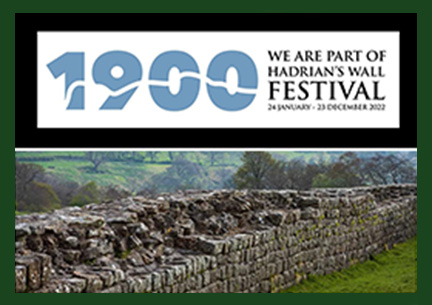
The enduring ruins of Hadrian's Wall spanning across northern England.
The W8USR Logbook Entry & Research
On February 17, 2022, I spun the dial onto 14.232 MHz and caught the special event callsign GB1900HW coming in from England. I was able to successfully make contact with the operator, Roy Nicholson (M0TKF), who was transmitting from Hexham, Northumberland. While I clearly logged GB1900HW that afternoon, I never did happen to hear the sibling station, GB1900HA, out on the air waves.
Station Note: Very little was initially known to me regarding the exact background of this event. My primary record amounts to just a single line inside my physical paper logbook. Pulling from that entry, I was able to research the history of the activation online to piece together the details listed below. These additional details are preserved here for historical context and informational purposes only, and are not positively confirmed by the station logs.
The Hadrian's Wall 1900 Festival (2022)
The year 2022 marked a monumental milestone for one of the world's most famous historical frontiers, prompting the launch of the community-led Hadrian's Wall 1900 Festival. This year-long celebration marked the 1,900th anniversary of the beginning of the wall's construction in AD 122. Extending across the entire 73-mile UNESCO World Heritage Site corridor—from Wallsend in the east to Bowness-on-Solway in the west—the festival brought together local communities, international artists, and passionate hobbyists. Its official calendar was bookended by two historically significant Roman dates: opening on January 24, the birthday of Emperor Hadrian, and concluding on December 23 during Saturnalia, the traditional Roman winter festival.
The festival featured a vibrant, diverse program of events that bridged ancient history with contemporary culture. Visitors experienced large-scale art installations, guided archaeological walks, theatrical performances, and historical reenactments that vividly brought the Roman era back to life. Among these creative endeavors was a unique contribution from the amateur radio community. Operators utilized two special event callsigns—GB1900HA (operated by Austin Vaughan, M0MNE, from South Shields) and GB1900HW (operated by Roy Nicholson, M0TKF, from Hexham)—to transmit the story of the wall across global airwaves. Utilizing High Frequency (HF) and Very High Frequency (VHF) bands across Voice (SSB), Morse Code (CW), and digital data modes, these operators connected with thousands of enthusiasts worldwide, turning a local British celebration into a global interactive event.
The History of Hadrian's Wall
The origin of Hadrian's Wall dates back to AD 122, when the Roman Emperor Hadrian visited Britain and ordered the construction of a massive stone and turf barrier. At the time, the Roman Empire was shifting its foreign foreign policy from aggressive territorial expansion to consolidation and defense. Built by three Roman legions stationed in Britain, the wall spanned 73 miles (80 Roman miles) across the narrowest neck of northern England. It was designed not merely as a passive defensive shield against the unconquered Caledonian tribes of modern-day Scotland, but as a highly visible psychological symbol of Roman military might, imperial authority, and administrative control.
Structurally, the wall was a masterpiece of ancient military engineering. While the eastern section was meticulously constructed from stone, the western portion was initially built using packed turf and timber, though it was later upgraded to stone. The barrier was heavily fortified with a clever, repeating defensive system. Every Roman mile featured a milecastle—a small fortified gatehouse that controlled and monitored the flow of trade and people across the frontier. Between these milecastles sat smaller stone turrets used for observation and signaling, while larger, self-contained military forts like Housesteads, Chesters, and Arbeia housed thousands of auxiliary soldiers who patrolled the line.
Life along the wall was a complex tapestry of military discipline and cultural integration. The frontier quickly grew into a bustling, diverse economic zone where Roman soldiers from all corners of the empire—including North Africa, Gaul, and Spain—interacted daily with the local British population. Civilian settlements, known as vici, naturally sprang up just outside the fort walls. These settlements featured lively marketplaces, taverns, bathhouses, and temples, creating a unique hybrid of Roman and indigenous cultures.
The wall remained the definitive, heavily fortified northern frontier of the Roman Empire for nearly three centuries. It was briefly superseded in the 140s by the turf-built Antonine Wall further north, but Roman forces quickly retreated back to Hadrian's stronghold. The complex system was ultimately abandoned in the early 5th century as the Roman administration collapsed and legions withdrew from Britain. In the centuries that followed, local populations recycled much of the Roman stone to build nearby castles, houses, and churches. Today, the enduring ruins stand as a spectacular World Heritage Site, offering an invaluable window into the scale and ambition of the Roman Empire.
Station Log: Contact History
| Special Event Call | Station Logged | Date Logged | Time Logged | Frequency | Frequency Band | Operation Mode | Signal Report | On-Board Operator |
|---|---|---|---|---|---|---|---|---|
| GB1900HW | W8USR | February 17, 2022 | 15:13 UTC | 14.232 MHz | 20 Meters | SSB Phone | Sent 58 / Recv 54 | Roy (M0TKF) |