W8USR - Special Events
The Eagle Has Landed – GB5EHL Apollo 11 50th Anniversary
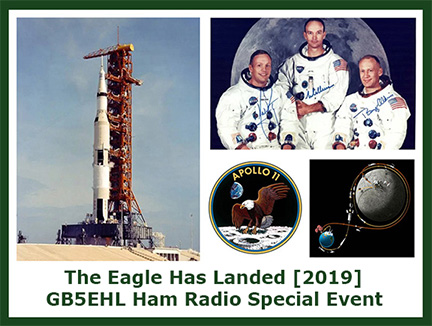
About the Special Event
On July 5, 2019, station W8USR executed a remarkable trans-Atlantic contact by logging special event station GB5EHL, operated by the Leicester Radio Society in the United Kingdom. This unique deployment celebrated the 50th anniversary of the historic Apollo 11 moon landing of July 20, 1969. The call sign suffix directly references Neil Armstrong's legendary transmission: "The Eagle Has Landed." Operating as part of a global amateur radio network alongside major NASA club stations, the Leicester team concluded their active month-long broadcast on July 28, 2019.
Gray-Line Propagation Breakthrough
Because July 2019 sat right at the absolute bottom of Solar Minimum for Cycle 24, sunspot counts frequently hit zero, leaving standard daytime higher-band propagation practically non-existent. Making this trans-Atlantic contact required a textbook utilization of Gray-Line propagation on 20 meters. By operating precisely along the dawn/dusk terminator separating Michigan and the UK, the signal capitalized on a rapid drop in D-layer absorption while maintaining a highly charged F-layer. This created a brief, highly efficient "tunneling" window that allowed the signal to span the Atlantic with minimal signal loss before the terminator shifted.
Station Infrastructure & Power Layouts
The Leicester Radio Society maintained a highly aggressive international footprint to cut through the dead ionospheric conditions:
- Power Restrictions & Limits: In the UK, Full License club stations are legally capped at 400 Watts PEP. To punch through the solar minimum, the operators ran a linear amplifier up to the absolute legal limit of 400 Watts for maximum trans-Atlantic drive.
- Multi-Mode Deployment: While the primary logbooks tracked robust Single Sideband voice (SSB) and Morse code (CW) pile-ups, the station also utilized RTTY, SSTV, PSK, and modern FT8 digital networks.
- Global Coordination Context: GB5EHL was cross-listed alongside prominent US space stations at the Kennedy Space Center and Marshall Space Flight Center, as well as European activations like PA11APOLLO in the Netherlands.
- Logbook Source Note: Due to limited historical records online, the core operational parameters are derived from a single-line paper log entry. Additional technical details reconstructed via web research are included for educational context.
History of the Apollo 11 Mission
The Apollo 11 lunar landing on July 20, 1969, represented the ultimate realization of President John F. Kennedy's 1961 challenge to land an American safely on the Moon before the close of the decade. This monumental initiative drove unprecedented technological development and a rigorous series of crewed testing missions (Apollo 7 through 10) to validate the complex orbital mechanics and spacecraft systems. The prime crew chosen for the historic journey consisted of Commander Neil Armstrong, Lunar Module Pilot Edwin "Buzz" Aldrin, and Command Module Pilot Michael Collins.
On July 16, 1969, a massive Saturn V rocket launched the crew from the Kennedy Space Center in Florida. After a three-day, 240,000-mile transit through the void, the spacecraft entered lunar orbit. On July 20, Armstrong and Aldrin entered the Lunar Module Eagle and detached from the Command Module Columbia. During the final descent, the guidance computer triggered unexpected executive overflow alarms. Armstrong assumed manual control, piloting the module past a boulder-strewn crater to touch down safely in the Sea of Tranquility with only seconds of fuel remaining. Armstrong triumphantly radioed back to Earth: "Houston, Tranquility Base here. The Eagle has landed."
Scientific Legacy of the EASEP Deployment
Hours after landing, Commander Neil Armstrong stepped onto the lunar surface, declaring, "That's one small step for [a] man, one giant leap for mankind." Because the crew had only 2.5 hours on the surface and faced immense uncertainties about working in pressurized suits, they left behind a streamlined, scaled-down science suite called the Early Apollo Scientific Experiments Package (EASEP), which permanently transformed our understanding of the solar system:
- Laser Ranging Retro-Reflector (LR3): A simple array of specialized mirrors and the only Apollo 11 experiment still operating today. Earth-based observatories fire lasers at the reflector to measure transit time, tracking the Moon's exact distance and proving it is slowly drifting away from Earth at 1.5 inches per year.
- Passive Seismic Experiment Package (PSEP): The first seismometer placed on another world. Powered by solar arrays and an isotope heater, it detected thousands of moonquakes and meteoroid impacts, proving the Moon possesses active internal seismic shifts rather than being a dead rock.
- Lunar Dust Detector: A tiny device built to measure dust accumulation. Rocket exhaust coated instruments during liftoff, proving that abrasive lunar dust clings to spacesuits and equipment, creating a significant obstacle by causing hardware to overheat.
Symbolic Artifacts Left Behind
Beyond scientific gear, the crew left four historic items to mark humanity's first footprint on another world:
- The Goodwill Disk: A coin-sized silicon disc containing scanned messages of peace from leaders of 73 nations, along with lists of U.S. government officials and NASA administrators.
- Commemorative Space Medals: Medals honoring fallen space explorers, including Soviet cosmonauts Yuri Gagarin and Vladimir Komarov, as well as the three American astronauts who died in the tragic Apollo 1 fire.
- The Lunar Plaque: A stainless-steel plaque attached to the ladder of the descent stage (which remains on the Moon), signed by the crew and President Richard Nixon. It reads: "Here men from the planet Earth first set foot upon the Moon July 1969, A.D. We came in peace for all mankind."
- The Gold Olive Branch: A small solid gold pin left on the surface by Neil Armstrong as a traditional global symbol of peace.
On July 21, the ascent stage successfully lifted Armstrong and Aldrin off the surface to dock with Collins in orbit. The crew completed their return transit and splashed down safely in the Pacific Ocean on July 24, 1969, realizing the national vision and marking a monumental milestone in human history.
Station Log: Contact History
| Special Event Call | Station Logged | Date Logged | Time Logged | Frequency | Frequency Band | Operation Mode | Signal Report | On-Board Operator |
|---|---|---|---|---|---|---|---|---|
| GB5EHL | W8USR | July 5, 2019 | 20:31 UTC | 14.250 MHz | 20 Meters | SSB Phone | 57 | LRS Operator |