W8USR - Special Events
National Code Talker's Day
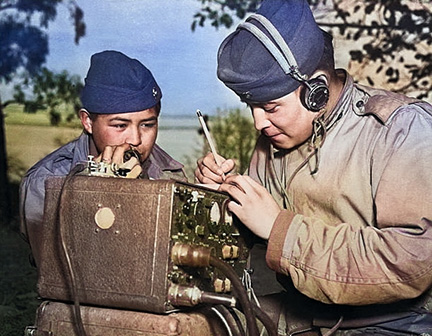
Event History & Significance
The concept originated during World War I, when the U.S. military realized their standard codes were frequently intercepted by German intelligence. A group of 14 Choctaw men serving in the 142nd Infantry Regiment, 36th Division, began using their indigenous tribal language as a secure, unbreakable battlefield code to relay messages. The Germans were completely unable to translate them, turning the tide of key engagements in France. Soldiers from the Cherokee, Comanche, and Osage nations also utilized their languages for secure communications during WWI.
While WWI laid the groundwork, it was in WWII that the U.S. military formally established a specialized Code Talker program. Philip Johnston, the son of a missionary who grew up on the Navajo reservation, proposed using the Navajo language because it was highly complex, unwritten, and almost impossible to learn without lifelong exposure. With that, an original group of 29 Navajos developed an indecipherable and "Unbreakable" code that became vital to Allied victories in major battles like Iwo Jima and Guadalcanal.
The system utilized a two-part code. First, they used Navajo words for English letters (e.g., wol-la-chee for "ant" to represent the letter "a"). Second, they created Navajo substitutions for military terms. For example, a submarine was besh-lo ("iron fish"), and a fighter plane was dah-he-tih-hi ("hummingbird").
Speed and Efficiency: Because the men memorized the entire 17-page code, they could transmit and receive complex messages in seconds, bypassing the time-consuming process of enciphering and deciphering with bulky machines.
Deployment and Legacy
Over 400 Navajos served as Marines in the Pacific theater, seeing action in every major Marine assault from 1942 to 1945. The Navajo Code Talkers were officially recognized for their contributions in 1968, and the original 29 were awarded the Congressional Gold Medal in 2001.
Station Log: Contact History
| Date / Year | Special Event Call | My Callsign Used | Time (UTC) | Band | Mode |
|---|---|---|---|---|---|
| August 11, 2007 | N7C | W8USR | 21:08 UTC | 20 Meters | SSB |