W8USR - Special Events
95th Anniversary of Charles Lindbergh's Transatlantic Flight
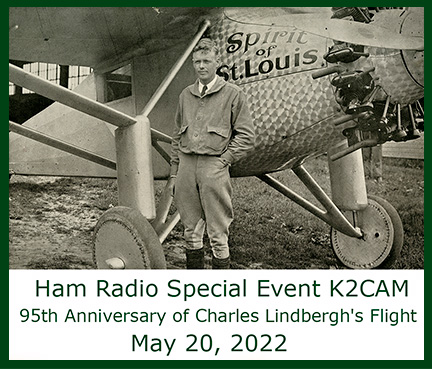
Commemorating the 1927 New York to Paris solo transatlantic flight.
The W8USR Logbook Entry & Event Overview
On May 20, 2022, the Cradle of Aviation Museum hosted a special on-air event in direct conjunction with the Long Island Amateur Radio Club (LIMARC). Operating using K2CAM, the official club call sign of the museum, club members volunteered as control operators to handle the high volume of incoming radio traffic worldwide. I tracked down the signal on the 40-meter band, logging a successful contact to commemorate the 95th Anniversary of Charles Lindbergh's historic 1927 solo transatlantic crossing.
About the Cradle of Aviation Museum
The story of Long Island’s Hempstead Plains is essentially the story of the birth of modern aviation. The open, treeless landscape made it a magnet for early flyers, paving the way for world-changing historical feats. Long before it became one of the country's most famous shopping centers, Roosevelt Field was the premier airport in the United States, spanning across several distinct historical eras.
From 1909–1916, it was originally known as the Hempstead Plains Aerodrome. The site first drew pioneers like Glenn Curtiss, who won major aviation prizes flying over the plains, and flying schools quickly set up camp there. In 1917, the U.S. Army leased the land, turning it into a massive military training hub known as Hazelhurst Field. Then in 1919, the airfield was permanently renamed Roosevelt Field to honor Quentin Roosevelt, President Theodore Roosevelt’s youngest son and a fighter pilot who was tragically killed in combat over France.
Throughout the 1920s and 1930s, Roosevelt Field was the absolute epicenter of global flight. Charles Lindbergh famously took off from its muddy, rain-soaked runway on May 20, 1927, bound for Paris on his world-altering solo transatlantic flight. Other icons like Amelia Earhart and Wiley Post regularly flew out of the complex. It featured an impressive array of hangars, its own newspaper, aircraft sales agencies, and a famous aviation inn.
Because of the heavy concentration of early airfields (including Roosevelt, Curtiss, and Mitchel Fields) and massive manufacturing hubs on Long Island, the region was widely nicknamed the "Cradle of Aviation". The Cradle of Aviation Museum was established in Garden City, New York, right on Museum Row to preserve this massive industrial and exploratory heritage. It is physically built on the former grounds of Mitchel Air Force Base and actually incorporates restored, historic military hangars into its architectural design.
Long Island wasn't just a place where people flew; it was where planes were made. Local aerospace giants like Grumman and Republic Aviation built 46% of U.S. fighter planes during World War II, and the museum highlights that massive home-grown contribution. Today, the museum boasts over 75 historically significant air and spacecraft displayed across eight immersive galleries. Notable permanent exhibits include the Grumman F-14 Tomcat (a local Long Island manufacturing triumph), an authentic, unused Apollo Lunar Module (LM-13) built right down the road in Bethpage by Grumman for the aborted Apollo 19 mission, the Catholic Health Sky Theater Planetarium with a giant 70mm dome, and a 1918 Curtiss Jenny aircraft that Charles Lindbergh actually used during his early barnstorming days.
History for Charles Lindbergh and the Spirit of St. Louis
On the rainy morning of May 20, 1927, a 25-year-old former airmail pilot named Charles Lindbergh climbed into a custom-built, single-engine monoplane named the Spirit of St. Louis. He took off from a muddy, dangerously short runway at Roosevelt Field, Long Island, chasing the $25,000 Orteig Prize for the first non-stop flight between New York and Paris.
To maximize fuel capacity for the grueling journey, Lindbergh made radical, life-threatening structural sacrifices:
- Radio and Safety Equipment: He refused to carry a heavy wireless radio or even a parachute, choosing instead to carry extra weight in fuel.
- Visibility Sacrifices: A massive fuel tank was placed directly in front of the cockpit, completely eliminating forward visibility. He could only see straight ahead by using a tiny, makeshift periscope.
- Dangerous Payload Weights: The plane weighed over 5,000 pounds on takeoff—nearly double its empty weight—barely clearing the telephone wires at the end of the muddy runway.
For the next 33.5 hours, Lindbergh battled extreme elements entirely alone. As he flew over the freezing North Atlantic, his greatest enemy wasn't the weather or the mechanics of the plane, but profound sleep deprivation. Having been awake for 24 hours before takeoff, he suffered from intense hallucinations, at times believing he saw phantom spirits in the cockpit with him. He flew just feet above the ocean waves to catch the moist air, using the sting of cold sea spray to force himself awake.
On the evening of May 21, 1927, after navigating strictly by dead reckoning and stars, Lindbergh spotted the coast of Ireland. A few hours later, at 10:22 PM local time, he touched down at Le Bourget Field in Paris. An overwhelming crowd of over 150,000 roaring spectators stormed the airfield, pulling Lindbergh from the cockpit and cementing him instantly as a global icon. His historic 3,600-mile solo flight proved to the world that long-distance commercial aviation was not a fantasy, but the definitive future of global transportation.
Station Log: Contact History
| Special Event Call | Station Logged | Date Logged | Time Logged | Frequency | Frequency Band | Operation Mode | Signal Report | On-Board Operator |
|---|---|---|---|---|---|---|---|---|
| K2CAM | W8USR | May 20, 2022 | 17:23 UTC | 7.240 MHz | 40 Meters | SSB Phone | Sent 59 / Recv 59 | Club Op |