W8USR - Special Events
50th Anniversary of the Apollo 8 Mission and Crew
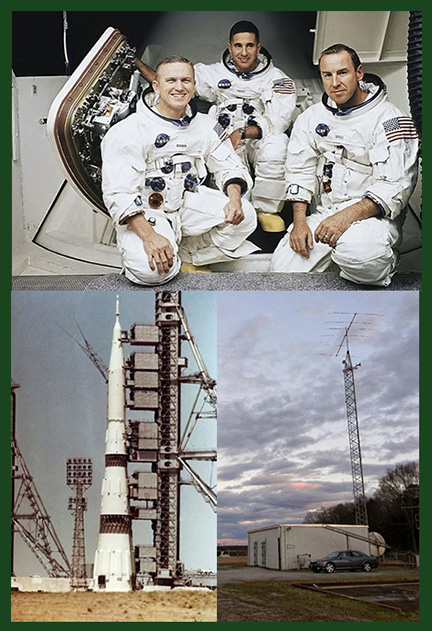
About the Special Event
This special event celebrated the 50th Anniversary of the Apollo 8 mission and its crew. It was hosted by the Marshall Amateur Radio Club in December 2018 as part of the NASA On The Air (NOTA) national program using their club callsign NN4SA. The activation broadcasted directly from their club station, a former liquid hydrogen (LH2) test site blockhouse located at the Marshall Space Flight Center, Redstone Arsenal, in Huntsville, Alabama.
The Geopolitical Chessboard
Apollo 8’s 1968 mission was a high-stakes Cold War gambit. The year 1968 was heavily fractured by riots, war, and political assassinations. Against this chaotic backdrop, a high-stakes Cold War gamble was quietly playing out between superpowers. In September 1968, the Soviet Union successfully launched the uncrewed Zond 5 spacecraft, carrying a living payload of two Russian tortoises, fruit fly eggs, and mealworms around the Moon and back to a safe splashdown. Intelligence reports warned NASA that this was a final dress rehearsal before the Soviets put cosmonauts aboard a similar flight. Spied on by satellites, a team of Soviet cosmonauts was already stationed at the launch site, actively lobbying the Kremlin for permission to fly by December. NASA, meanwhile, was severely bogged down by manufacturing and electrical bugs in its Lunar Module, threatening to push the American timeline past 1969.
Fearing a massive Soviet propaganda victory, NASA manager George Low proposed an audacious pivot: strip the delayed Lunar Module from the upcoming schedule entirely and send Apollo 8 directly to the Moon using only the Command and Service Modules. This meant flying without a lander—the very vehicle that would later act as a critical "lifeboat" on Apollo 13. If the primary engine failed, the crew would be permanently stranded in deep space. NASA accepted this extreme vulnerability solely to beat the Soviets to lunar orbit.
The Human Toll
Behind NASA’s pristine public image, the families of the Apollo 8 crew lived through agonizing psychological strain during the Christmas of 1968. Commander Frank Borman was brutally honest with his wife, Susan, calculating their chances of returning alive at exactly 50/50. Under strict exclusive contracts with Life magazine, the wives—Susan Borman, Marilyn Lovell, and Valerie Anders—were expected to look flawlessly serene for the press, maintaining an image of domestic perfection while dealing with inner terror.
Susan Borman privately visited NASA flight executives before launch, demanding to know what would happen if the spacecraft’s main engine failed to ignite on the far side of the Moon. The executives quietly confirmed her worst fear: the crew would be trapped in permanent lunar orbit until their oxygen ran out. This constant threat of public widowhood accelerated a battle with hidden depression and anxiety for Susan. Meanwhile, right before the launch, Marilyn Lovell suffered a terrifying nightmare that the capsule would be lost in space, forcing her to hide her panic from her children as she attended Christmas Eve mass alone.
A Narrative of Pure Might
Propelling these families' hopes into the cosmos was the Saturn V launch vehicle, a staggering engineering triumph standing 363 feet tall and weighing 6.5 million pounds when fully fueled. Rather than firing all at once, the rocket achieved its immense power through three distinct, discarded stages.
The journey began with the First Stage (S-IC), built by Boeing. Standing 138 feet tall, this massive component acted as "The Muscle" of the operation. Powered by five Rocketdyne F-1 engines burning RP-1 rocket kerosene and liquid oxygen, it generated a blinding 7.5 million to 7.75 million pounds of thrust. For 168 seconds, its turbopumps forced propellant into the combustion chambers at an unbelievable 42,500 gallons per minute, burning its entire multi-million-pound fuel supply to lift the heavy stack off the pad and through Earth's dense lower atmosphere.
Once empty, the first stage detached, giving way to the Second Stage (S-II), manufactured by North American Aviation. Measuring 81.5 feet tall, this stage acted as "The Accelerator." It utilized five Rocketdyne J-2 engines powered by a highly volatile mixture of liquid hydrogen and liquid oxygen. Generating roughly 1,155,800 pounds of thrust in the vacuum of space, it burned for 360 seconds, pushing the spacecraft to the very edge of space and nearly reaching orbital velocity.
Finally, the Third Stage (S-IVB), built by the Douglas Aircraft Company, took over as "The Navigator." Standing 58.6 feet tall and utilizing a single Rocketdyne J-2 engine, it also burned liquid hydrogen and liquid oxygen to produce 232,250 pounds of vacuum thrust. This stage split its 500-second burn time into two separate events: the first inserted the crew into a temporary Earth parking orbit for vital systems checks, and the second, known as Translunar Injection, fired again to break Earth's gravity entirely. All of this raw power was controlled by the Instrument Unit, an independent IBM-built brain ring mounted at the top of the third stage that managed guidance and engine cutoffs completely outside the astronauts' direct controls.
Technical Crises in Deep Space
Once in deep space, the crew quietly overcame two major technical and physiological crises. Shortly after leaving Earth's orbit, Frank Borman experienced a severe, sudden bout of vomiting and diarrhea. In microgravity, waste floated freely, forcing the crew to spend hours cleaning the inside of the capsule. Mission Control initially feared a contagious virus had incapacitated the crew, but post-flight medical debriefings revealed it was actually one of the first documented cases of Space Adaptation Syndrome, prompted by the larger capsule allowing more free-floating movement. This incident forced NASA to permanently add anti-nausea medications to all future medical kits.
Later, on the return journey, an exhausted Jim Lovell accidentally entered an incorrect command into the Apollo Guidance Computer, punching in a program code that mistakenly told the computer the spacecraft was still resting on the launchpad back on Earth. Believing it was out of position, the spacecraft immediately fired its thrusters and flipped itself nose-up. Because the computer completely lost its physical orientation matrix, Lovell had to use the spacecraft’s optical telescope to manually perform a course sighting, tracking down known navigational stars to input coordinates and recalibrate the system. This nerve-wracking crisis accidentally gave Lovell the exact manual navigation experience he needed to successfully pilot the crippled Apollo 13 mission 16 months later.
The Christmas Eve Broadcast and Waste Realities
On Christmas Eve, December 24, 1968, the crew entered lunar orbit. While orbiting, William Anders captured the iconic "Earthrise" photograph, showing a vibrant blue Earth hanging over a barren lunar landscape. During their ninth orbit, they conducted a live television broadcast seen by an estimated one billion people. Behind the majestic words, the physical reality inside the capsule remained primitive. Without a modern space toilet, waste management relied entirely on plastic bags with adhesive rims that the astronauts had to tape to their bodies, followed by the manual insertion of a blue germicidal liquid to stop gas formation. Urine was dumped directly into space via a vacuum tube system.
The Christmas Eve Genesis Transcript
Recited by astronauts Bill Anders, Jim Lovell, and Frank Borman during their live television broadcast:
Bill Anders
We are now approaching lunar sunrise, and for all the people back on Earth, the crew of Apollo 8 has a message that we would like to send to you.
In the beginning God created the heaven and the earth.
And the earth was without form, and void; and darkness was upon the face of the deep. And the Spirit of God moved upon the face of the waters.
And God said, Let there be light: and there was light.
And God saw the light, that it was good: and God divided the light from the darkness.
Jim Lovell
And God called the light Day, and the darkness he called Night. And the evening and the morning were the first day.
And God said, Let there be a firmament in the midst of the waters, and let it divide the waters from the waters.
And God made the firmament, and divided the waters which were under the firmament from the waters which were above the firmament: and it was so.
And God called the firmament Heaven. And the evening and the morning were the second day.
Frank Borman
And God said, Let the waters under the heaven be gathered together unto one place, and let the dry land appear: and it was so.
And God called the dry land Earth; and the gathering together of the waters called he Seas: and God saw that it was good.
And from the crew of Apollo 8, we close with good night, good luck, a Merry Christmas – and God bless all of you, all of you on the good Earth.
The Aftermath and Legal Backlash
On Christmas Day, the crew successfully fired their engine to break orbit, prompting Jim Lovell to famously radio, "Please be informed... there is a Santa Claus." The command module splashed down safely in the Pacific Ocean on December 27, 1968. The mission's telemetry proved that deep-space navigation worked flawlessly, directly enabling the Apollo 11 moon landing seven months later. Coming at the end of a heavily fractured year, the crew received a famous telegram from a citizen stating: "Thank you Apollo 8. You saved 1968."
Following the broadcast, Madalyn Murray O'Hair filed a lawsuit against the United States government, arguing that by televising a positive message, reading from the Book of Genesis while in lunar orbit, the crew violated the First Amendment. Though the Supreme Court ultimately dismissed the lawsuit, upholding the Constitution, the legal backlash rattled NASA, leading the agency to strictly advise future astronauts against broadcasting explicit religious ceremonies from space.
In the dead of winter during one of the most violent, fractured years in American history, three men sat suspended in a tiny aluminum pod a quarter-million miles from home, staring at an engine switch. If it failed to ignite, they would drift in the silence of lunar orbit forever; if it fired, they would return to an Earth they had just completely redefined by looking back at it. Apollo 8 did not just win the first leg of the space race — it proved that humanity’s greatest leaps require stepping out over a void where the survival odds are nothing more than a coin toss.
Station Log: Contact History
| Date / Year | Special Event Call | My Callsign Used | Time (UTC) | Band | Mode | RST |
|---|---|---|---|---|---|---|
| December 22, 2018 | NN4SA | W8USR | 22:49 UTC | 40 Meters | SSB | 59 |